The effect map is an extremely effective method to identify what an interactive solution should contain. It tells you which features are adding value to the business and which should be avoided.
The effect map is the main tool in effect management method underlying all the design work I do. The Effect map is used as a foundation for identifying requirements. It centers around the idea that only the features contributing to an actual need from a user can be expected to give any return on investment. In this way guidance to what interactive system should contain.
Setting up an Effect Map is usually done in a workshop where all major stake holders are invited. In this workshop the participants are asked a few very specific questions. The answer to each question leads to the next.
Were business and user goals meet

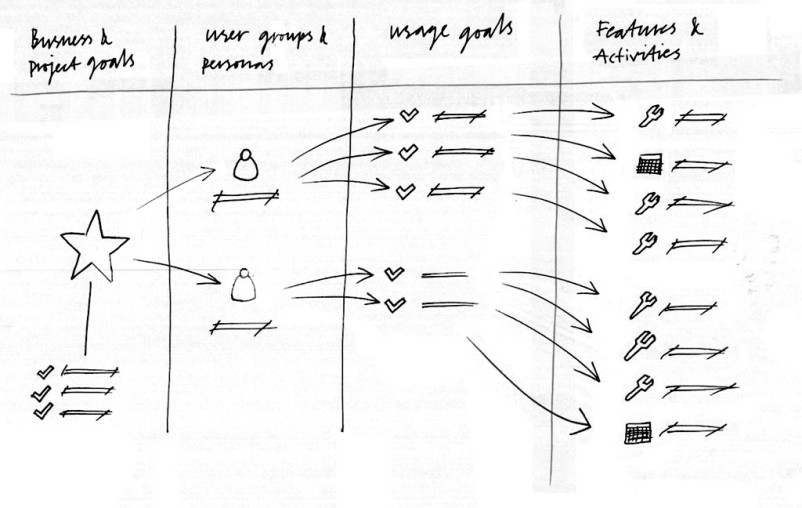
The effect map is a way to connect business goals to the user groups and their goals when using the solution. Each respective feature in the software is connected to one or more usage goal to ensure that the feature will be used and thereby add value to the business.
- The first question is: “What are the business goals” The answer defines what larger good the interactive soulution should contribute to.
- The next question is: “Who will, by using the system, ensure that the business goals are fulfilled.” The answer determines which tartget groups the system should be designed for. The defined groups are prioritized.
- Then follows the key question: “What goals do these users have while using the software”. The defined usage goals are then also prioritized.
- The last question should not be asked before the usage goals are stated and prioritized: “What features would fulfill the users goals as well as the business goals” By prioritizing the stated features connected to each usage goal.
When all the questions are answered the result will be a well organized feature list sorted after importance and impact on the business. The most important function, fulfilling the goals of the primary target group should be developed before you go on the the next. In this way the Effect Map guides you through all stages of the design and development process. It also makes it much easier to manage bug reports and customer feedback after the system is released.
In this blog post i expand on why effect management has become so imortant to me as a designer.

I was asked to join the team at Merajobb, the collective job site for three of Sweden’s largest newspapers, to completely redesign their site. My role was to lead, analyze user needs, create a site concept and make sure no greatness was lost in the process. The team, consisting of the developers at HR north, designer Jonas Björkman from The Art of job and I completed the project in record speed.
Starting the design process can be overwhelming for any designer. There is always the risk of designing for the wrong target group or getting stuck in front of a blank Photoshop document. To be efficiente, all designers has to find well working methods for exploring design solution without draining the project budget. In my second presentation at Hyper Island, I shared two of my favorite design methods, effect mapping and visual moodboards!
Internet strategy, interactive marketing, interaction design and usability affects all businesses today. This became clear to me when I presented my point of view for the Alingsås marketing foundation, yesterday eventing. My goal was to get a brief insight in how to utilize the potential and opportunities that opens up for small businesses, when Internet penetration reaches all of us. Here is my presentation!
It is now exactly one year since I created the first conceptual sketches for this site. This seemingly simple project was one of the most challenging projects I have ever completed. The site really forced me to use all the methods I have normally use in my projects for clients and have consumed an unbelievable amount of effort to make it perfect in every respect. Here is the story of how it was created.
Creating successful results is the goal of every designer, however it is just a fraction of all interactive sites and solutions that get ahead and get profitable many hardly even getting noticed at all. As a designer I avoid just designing and focusing instead on designing for effect!
Since I started working with web sites and software applications there is one thing I haven’t been able to figure out. Why do people hold on to handling software requiremts in flat lists. This practice is hopelessly demanding and it often results in mediocre software or even grand project disasters. In this post I will talk about why we need to go on to better practices.